How to Recognize Concerning Behavior and Protect Children
As parents, it is natural to want clear, simple answers to difficult questions—especially when it comes to keeping children safe.
One of the most common questions people ask is how to “identify pedophiles.”
But the reality is important to understand: you cannot reliably identify someone with harmful intentions based on appearance, personality, or role in a community.
Because of that, child safety experts focus less on identifying individuals and more on recognizing patterns of behavior that may indicate grooming or boundary violations.
Protection comes from awareness, not assumptions.
The goal of this article is to help parents understand those behaviors and strengthen safeguards in any environment where children are cared for.
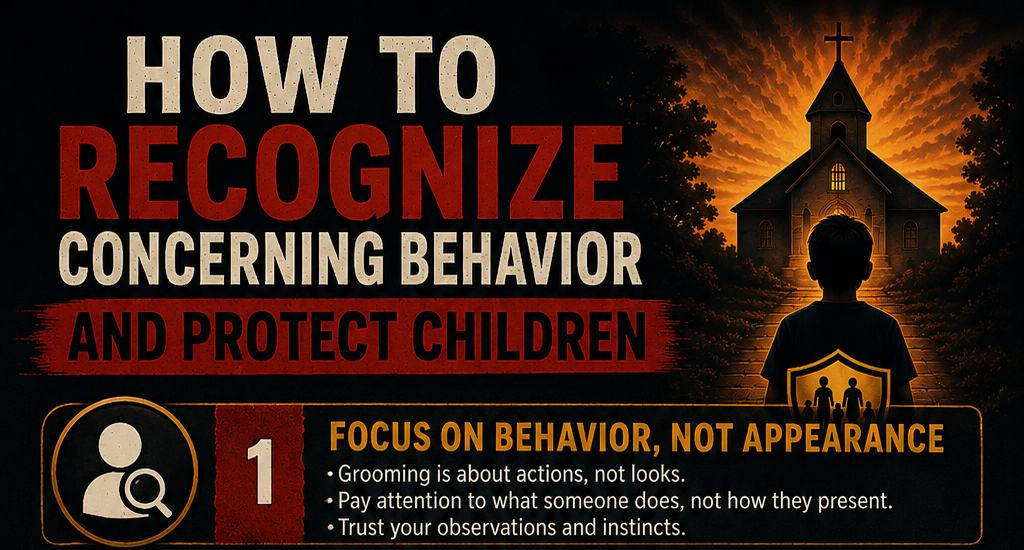
Focus on behavior, not appearance
There is no reliable physical trait, profession, or personality type that can be used to identify someone who may pose a risk to children. Attempts to “spot” individuals based on assumptions can lead to serious mistakes.
Instead, the most useful approach is to observe how adults interact with children over time, especially in structured environments like churches, schools, sports programs, and youth groups.
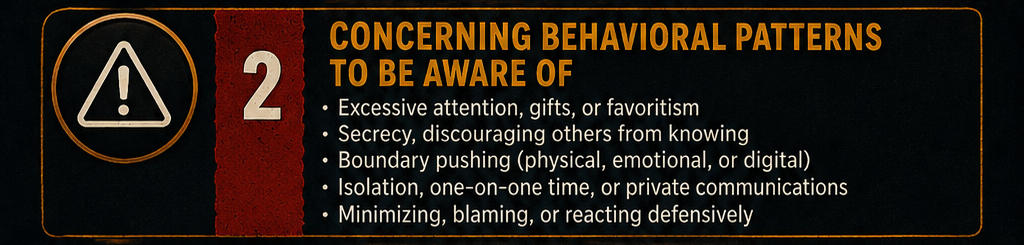
Concerning behavioral patterns to be aware of
While each situation is different, professionals often point to grooming as a gradual process that can include boundary-crossing behaviors such as:
• Giving a child special attention that is not given to others
• Attempting to build relationships with children outside normal group settings
• Showing a strong preference for spending time with children rather than peers
• Ignoring or minimizing parental boundaries or rules
• Creating situations where interactions are private or unsupervised
• Encouraging secrecy or private communication with a child
These behaviors do not automatically mean someone has harmful intent, but they are warning signs that warrant attention and accountability within any organization.

Concerning behavioral patterns to be aware of
Boundary respect is one of the strongest indicators of safety
Healthy adults working with children consistently respect boundaries.
That means:
• Allowing visibility in interactions
• Keeping communication appropriate and transparent
• Involving parents or guardians appropriately
• Following established rules without resistance
When someone repeatedly pushes against these boundaries or tries to operate outside them, that is a serious concern regardless of their role or reputation.

Children should never be placed in isolated trust situations
One of the most important safeguards in any youth-serving environment is reducing isolation. Risk increases when adults have repeated private access to children without oversight.
Safe organizations use protections such as:
• Two-adult supervision policies
• Open-door or visible classroom designs
• Clear rules about one-on-one interactions
• Accountability structures for volunteers and staff
These systems protect both children and adults by ensuring transparency.

Teach children about communication and trust
Children should be encouraged to speak openly about anything that makes them uncomfortable. This includes teaching them:
• They can always talk to a trusted adult
• They will not get in trouble for reporting concerns
• Secrets from parents or guardians are not appropriate when they involve adults
This kind of communication is one of the strongest protective tools a family can have.

Safety is built, not assumed
The most important takeaway is that child protection does not rely on guessing intentions. It relies on strong systems, clear boundaries, and consistent accountability.
Instead of trying to identify individuals based on assumptions, parents are far better protected by asking:
“Does this environment make it difficult for inappropriate behavior to occur and easy for concerns to be reported?”
That question leads to safer decisions than fear or suspicion ever will.
Protecting children is not about labeling people—it is about building environments where safety is the standard, not the hope.